
Runs on Atlassian · zero data egress
OpenAPI & Swagger docs your team will actually read, right in Confluence
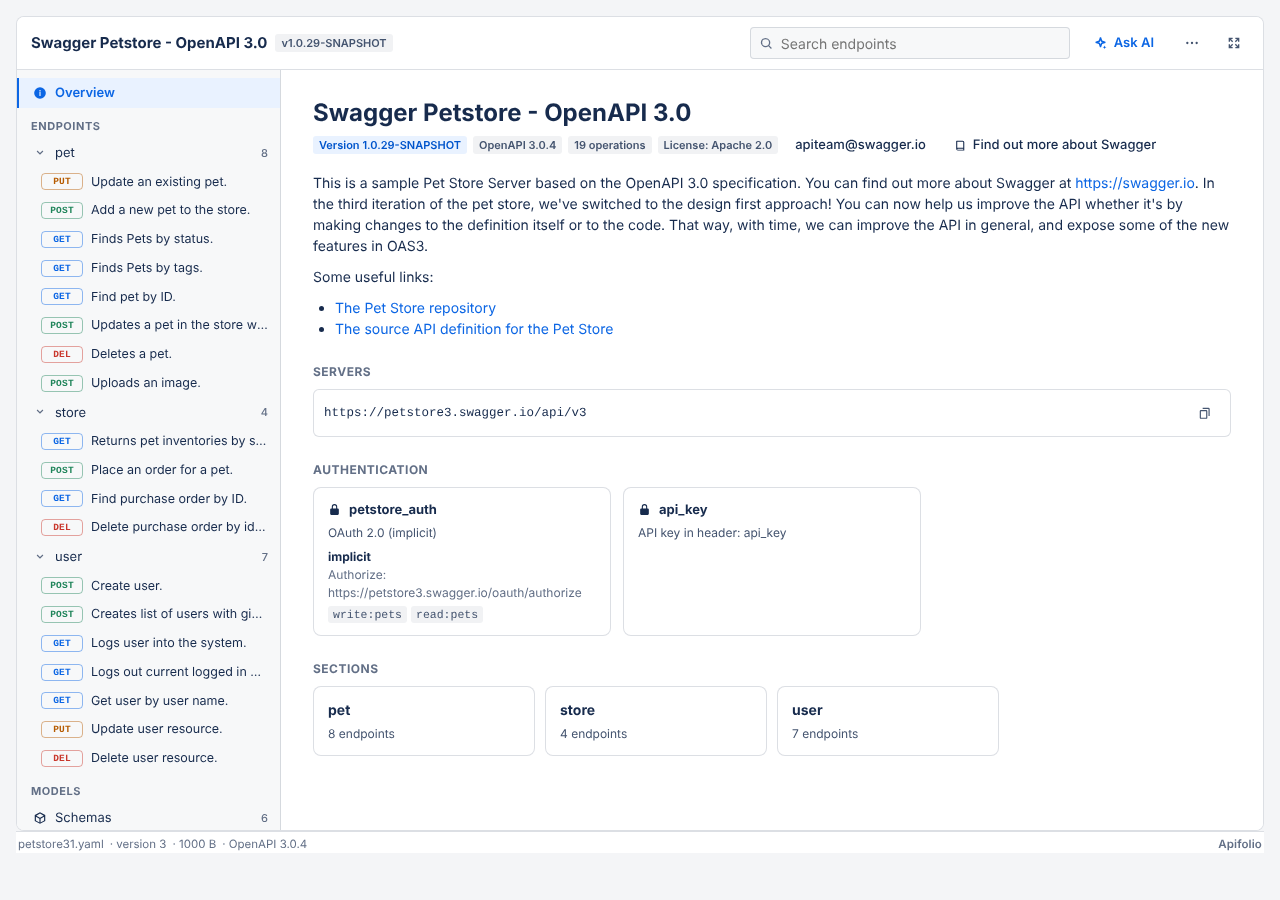
Attach an OpenAPI or Swagger file to a page and Apifolio turns it into a fast, searchable API reference with code samples in 17 languages, an offline request builder, PDF export and an AI expert. Your specs never leave Confluence.
Free for up to 10 users · 30-day free trial for larger sites
Everything your API docs need, nothing that leaks
Built from what Confluence users asked for in hundreds of reviews and forum threads: correct schemas, fast big specs, real exports and docs that are easy to find.
Modern, classic or one endpoint
A three-pane reference with navigation, docs and code side by side, the familiar Swagger UI style layout, or a compact card for one to three endpoints in a guide.
Search that understands developers
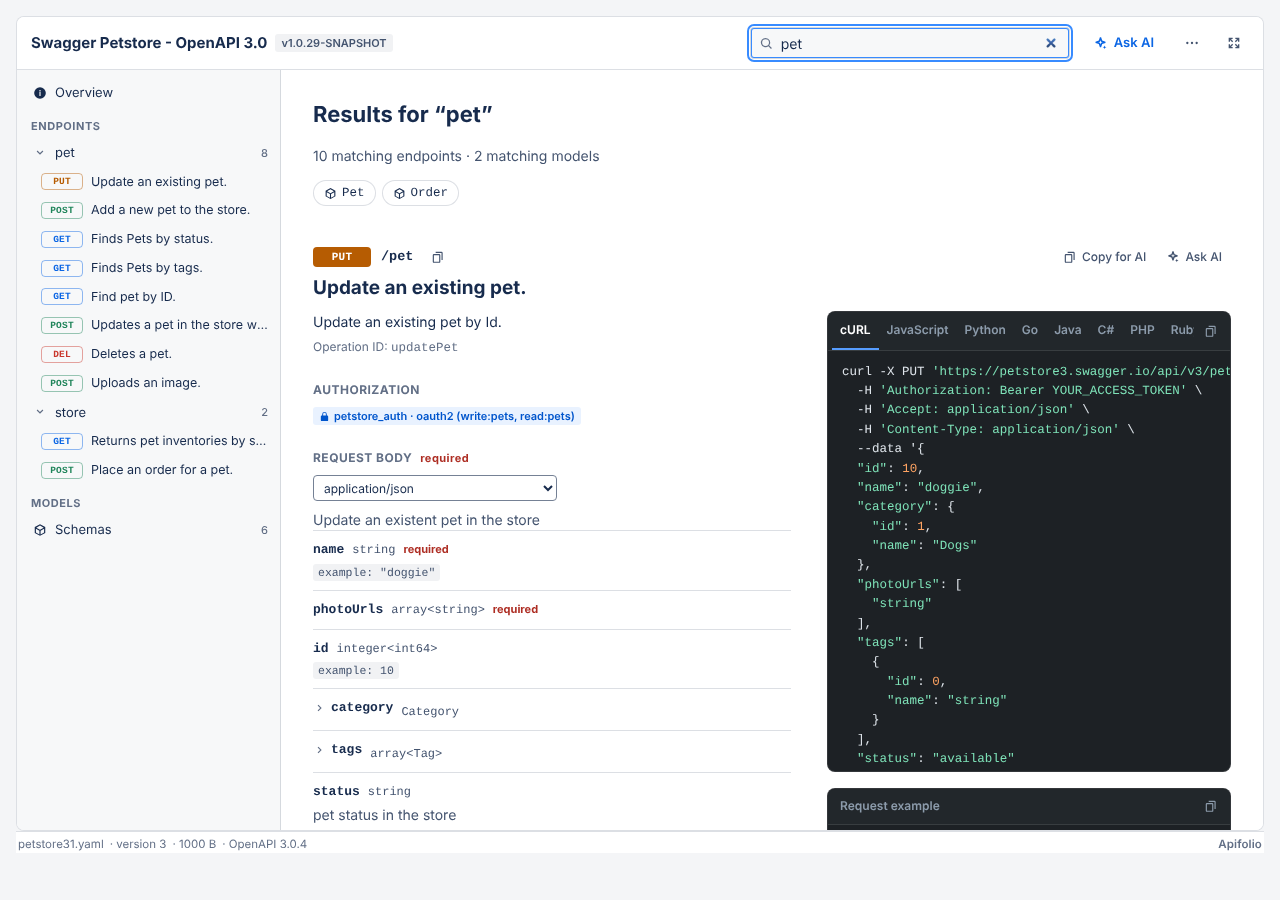
Endpoints, paths, operation IDs, parameters, field names and data models. Paste a URL from a log or make a typo: it still finds the endpoint. Press / or Ctrl+K.
Code in 17 languages
cURL, JavaScript, Python, Go, Java, C#, PHP and Ruby by default, plus PowerShell, HTTPie, Kotlin, Swift, Rust and more, with servers, parameters and auth placeholders filled in.
Edit request, nothing sent
Fill in parameters, the body, server variables and credentials, and every code sample and Copy for AI follow. Apifolio builds the request; you run it in your own tools.
Schemas that make sense
allOf merged; oneOf, anyOf and discriminator subtypes as switchable variants with one example each; recursion, read-only and write-only fields, Expand all.
Ready for AI
Copy any endpoint or the whole API as clean Markdown for ChatGPT, Claude or Copilot, or ask the Apifolio API Expert in Rovo.
PDF and Word that keep your docs
Exports contain endpoint tables, parameters, request and response fields, examples, cURL requests and data models, not an empty box.
Found by Confluence search
Operation IDs, paths and summaries go into Confluence search, so searching “refund a payment” finds the right page. The editor shows how many endpoints search covers.
Built for big APIs
Tested with GitHub's 10 MB spec and its 1,232 endpoints: parsed in about 0.2 s on a fast desktop PC, off the main thread, and rendered as you scroll.
Guests and public spaces
Anonymous visitors of public spaces and guests can read your API docs. For public links, paste a dated snapshot as native Confluence content.
Leaving a Connect app?
Insert Apifolio on the page: it imports the old OpenAPI or Swagger macro's spec and display options, and never copies stored credentials.
Docs that show their age
The footer says when the file changed, its version and its version comment (for example the commit from CI), with a link to the file's history.
Your specs never leave Confluence
- Runs on Atlassian's Forge platform, with no external servers
- No tracking, no analytics, no data egress
- Files are read as the current user, so page permissions always apply
- No stored credentials and no live calls to your APIs
- Data residency follows your Confluence site
Simple pricing
Billed by Atlassian with your Confluence subscription. Prices per user go down as your site grows.
Free
$0
Sites with up to 10 users
- Every Standard feature
- Unlimited pages and specs
- Email support
Standard
$1.25 / user / month
For the first 100 users, less above
- Modern and classic layouts
- Search, code samples in 17 languages
- Edit request (offline request builder)
- Copy for AI and the Rovo agent
- PDF and Word export
- Confluence search indexing
- Guests and public spaces
Pro Coming soon
$2.50 / user / month
For the first 100 users, less above
- Everything in Standard
- API catalog for the whole site
- Version comparison with breaking changes and a changelog
- Postman and .http export
- Spec quality score with a fix list
Questions
Does my spec leave Confluence?
No. Apifolio runs on Atlassian's Forge platform and is eligible for Runs on Atlassian. It sends no data to external servers, and it reads files as the current user, so page permissions apply.
Why is there no “Try it out” button?
Live requests would send data, and often credentials, from Confluence to servers outside Atlassian. Instead, Edit request fills in a ready-to-run request in 17 languages without sending anything, and you run it in your terminal or API client.
Which formats are supported?
OpenAPI 3.0, 3.1 and 3.2 and Swagger 2.0, in YAML or JSON, up to 25 MB.
Can I keep the spec in Git?
Yes. Upload new versions of the attachment from GitHub Actions, GitLab CI, Bitbucket Pipelines or Azure DevOps. The page shows the new version by itself.
Does it work in public spaces?
Yes. Guests and anonymous visitors of public spaces can read the docs for spec files attached to the same page (up to about 4 MB). For public links, paste a snapshot with Copy as Confluence content.
We use a Connect app that is being retired. Can we switch?
Yes. Atlassian ends Connect support on 31 January 2027. Insert Apifolio on the page: the dialog imports the old OpenAPI or Swagger macro's spec and display options, and never copies stored credentials.